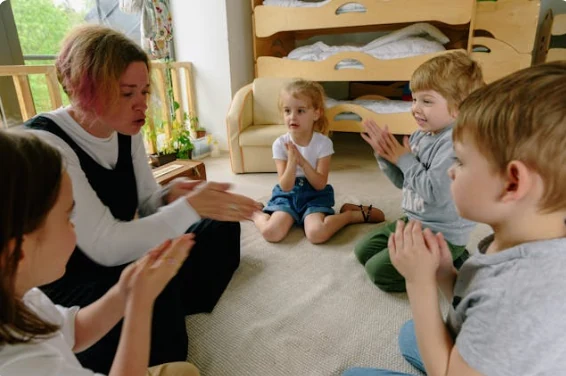
A ball drops in the middle of a circle. Instead of identifying who missed it, the children work out how to make the next pass easier. That small change gives the session a shared purpose: everyone has something to contribute.
For a school sports association, cooperative games offer a practical way to explore helping others. These ideas can be adapted for a small group, a family or a session with an activity leader.
A shared goal that keeps everyone involved
In a cooperative game, participants work towards a goal that needs more than one person’s contribution. USEP 44’s teaching resource emphasises listening, discussion and collective success. This creates opportunities to practise cooperation; it does not guarantee that disagreements disappear. 1
Cooperation can also be part of games involving opponents. The national USEP initiative “Avec ou contre, toujours ensemble” explores this relationship between shared rules, teammates and opposing players. Cooperation need not mean removing every element of competition. 2
Agree on three simple rules
Choose a clear space and lightweight equipment. Demonstrate a short instruction rather than giving a lengthy explanation. These rules offer a starting point:
- Keep others safe: no pushing, grabbing or sudden rough movements.
- Anyone can ask for a break or a different way to participate.
- Restart together and look for a solution without blaming someone.
The following games are editorial suggestions. The timings are examples, not targets. Adapt the space, equipment and pace to the group.
Three games to try
1. Around the circle
Equipment: a soft ball. Possible starting length: five minutes.
The group decides how to move the ball so that everyone receives it before it returns to the first player. Rolling it, handing it over or making a short pass all count. If it goes astray, simply restart.
Before another attempt, ask: “Who has not received the ball yet? How could we make their pass easier?” The challenge is to involve everyone rather than beat a compulsory record.
2. Partner mirrors
Equipment: none. Possible starting length: three minutes, then swap roles.
One child makes slow movements for a partner to copy: opening their arms, drawing a circle with their hands or gently moving their shoulders. Keep movements comfortable, without difficult balances or compulsory physical contact.
After swapping, each partner can choose a movement to keep. Playing side by side may feel easier than sustained face-to-face attention when children do not know each other well.
3. Movement messengers
Equipment: none. Possible starting length: five to eight minutes.
One participant invents a simple movement. The next repeats it and adds another. Together, the group creates a short sequence. Reminders and help are welcome; forgetting a movement never means leaving the game.
Keep the sequence short, then change who starts. Children might choose a garden, journey or imaginary animal theme. Stay in one place when space is limited.
Adapt the game for meaningful participation
USEP describes inclusion as something to prepare: understanding needs and adapting activities helps avoid leaving a child permanently watching or officiating. The aim remains shared physical participation. 3
| What you notice | An adjustment to explore with the child |
|---|---|
| The ball arrives too quickly | Roll it, shorten the distance or allow time to stop it. |
| Instructions are difficult to follow | Demonstrate one step, use a visual cue and practise together. |
| Noise makes participation difficult | Use a smaller group and a quiet visual signal. |
| Some movements are inaccessible | Offer a seated version or an equivalent movement the child chooses. |
These examples do not replace individual support when needed. Ask what helps without requiring anyone to share a diagnosis with the group.
The adult’s role: notice and rebalance
Who suggests every idea? Who waits without being included? Who always receives the hardest pass? Noticing these patterns gives the adult a chance to adjust the activity.
Offer everyone a turn to suggest something, bring players closer or simplify the task. Stop humiliation or unsafe behaviour. Calling a game cooperative does not remove the need for a protective environment.
End with a useful question
Ask: “What did another player do that helped you?” Then agree on one small adjustment for next time. Children do not need a score or a ranking for helpfulness.
Must everyone succeed immediately?
No. Finding a different strategy is part of the experience. Reduce the difficulty when repeated setbacks stop children enjoying the game.
Can different ages play together?
Yes, with suitable movements and roles. Check that older children are not doing everything and that younger ones genuinely take part, with adult support.